The timetable is the backbone of school life: it shapes teachers’ working days, pupils’ fatigue and how well rooms are used. It is also one of the hardest tasks for school leadership, because dozens of teachers, classes and rooms must be coordinated at once.
This article covers the criteria of a good timetable, the order in which to build it and the most common mistakes. The advice applies whether the timetable is built by hand or with software.
What makes a good timetable
A timetable can be judged by the following criteria:
- No clashes: a teacher, class or room is used by only one lesson at a time.
- No gaps for classes: pupils’ lessons run consecutively, with no free periods in between.
- Minimal teacher gaps: free periods are few and shared fairly among teachers.
- Even load: the number of lessons does not vary much between days of the week.
- Well-distributed subjects: a subject is not repeated on the same day, and demanding subjects are spread across the day and week.
- Constraints respected: methods days, part-time teachers’ hours, shifts and specialist rooms.
The order of work
- Prepare the teaching load. Each class needs a complete and accurate list of subjects, weekly hours and teachers. Mark subjects split into groups and alternating-week lessons in advance.
- Collect the constraints. Establish teachers’ methods days, part-time teachers’ hours, shifts and the availability of the gym, labs and computer rooms. Record hard requirements separately from preferences.
- Start with the hardest lessons. Place the most constrained lessons first: those needing specialist rooms, those split into groups and those of teachers who work at several schools. Easy lessons are left until last.
- Check the timetable. Check for clashes, class and teacher gaps, daily load and repeated subjects. Review every class and every teacher timetable separately.
- Distribute and keep it up to date. Deliver the timetable to teachers, form tutors and the electronic register. When changes are made, the new version must reach everyone at the same time.
Common mistakes
- Starting before the teaching load has been fully checked.
- Taking methods days and part-time teachers’ hours into account too late.
- Placing easy lessons first and leaving no room for difficult ones.
- Not re-checking the whole timetable after a single change.
- Sending the updated timetable to only some of the teachers.
When automation pays off
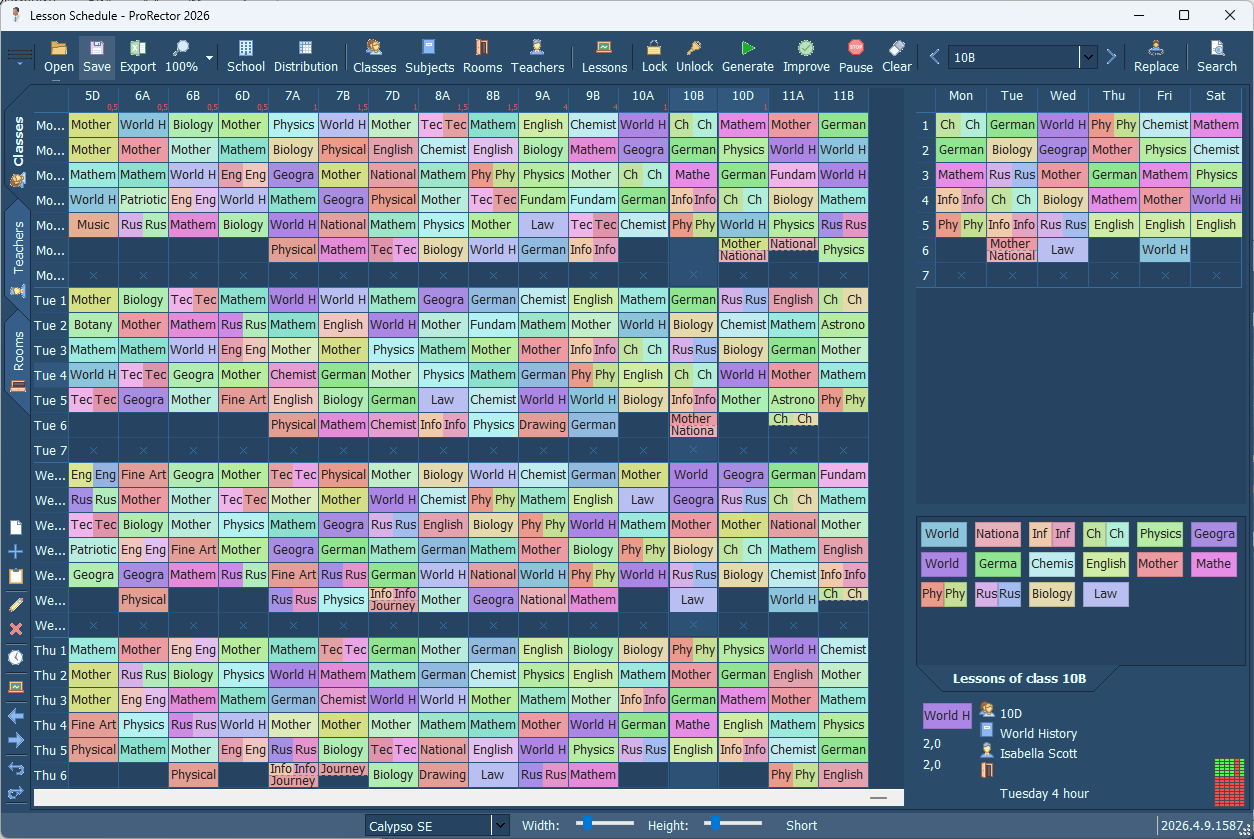
With more than 15–20 classes or many constraints, building a timetable by hand takes several days and the risk of errors grows. Software considers every condition at once and works through the options in minutes.
ProRector is designed for exactly this: it imports the teaching load from Excel, builds and optimises the timetable automatically, and distributes it via eMaktab.uz, Telegram and prorector.uz. See the Features page for details.
Conclusion
A good timetable has no clashes, few gaps, an even load and respects every constraint. Starting from a carefully prepared teaching load, placing the hardest lessons first and checking the result thoroughly saves time and prevents mistakes.
Try building your timetable with software
Download the ProRector demo and try it with your own school’s data.
Frequently asked questions (FAQ)
When should timetabling start?
Once the teaching load is approved, at least one to two weeks before the school year begins. This leaves time to check the timetable and take teachers’ requests into account.
What is a gap and how can gaps be reduced?
A gap is a free period between two lessons in a teacher’s or class’s timetable. To reduce gaps, schedule a teacher’s lessons consecutively, choose methods days carefully and give priority to teachers for whom gaps matter most.
When should demanding subjects be scheduled?
Demanding subjects (mathematics, languages, physics) are usually placed in periods 2–4, when pupils concentrate best, and spread evenly across the week. Follow your local health and safety regulations.
What is a two-week (week A/week B) timetable?
Some lessons take place every other week rather than every week. Such lessons are scheduled separately for odd and even weeks.
What should be checked in a finished timetable?
Clashes, class and teacher gaps, daily load, a subject repeated on the same day, methods days and room availability.